2025-11-17

Intent-Based Aggregators for Prediction Markets

Why intent-based aggregators will dominate retail prediction market volume


Prediction market interfaces continue to rely on legacy order types inherited from traditional financial exchanges. On platforms like Polymarket and Kalshi, users can submit two kinds of trades:

  1. Market order: takes liquidity off of the book and execute at the best available price
  2. Limit order: places liquidity on the book which will be matched if there is a requisite matching order

When a user sends a market or limit order, they are instructing the frontend to build a transaction with their exact parameters. The frontend then sends the constructed order to the orderbook matching engine. The user must decide exactly how their trade should execute, even if another venue, route, or execution path could deliver a better price.

In this post, I outline why intent-based aggregators will be the preferred retail prediction market interface and provide specific examples of novel orders enabled by intents.

A brief primer on intents

An intent is a set of constraints that allow a user to outsource transaction creation to a third party without relinquishing full control to the transacting party. They allow the user to tell a third party "what" they want without caring about "how" it is achieved.

These intents are typically sent to an aggregator. The aggregator is responsible for figuring out how to give the user the best price. Aggregators achieve this by asking a set of fillers for a quote and routing to the filler with the highest quote.

UniswapX was the first major aggregator to implement intents. Today, all the major DEX protocols operate as an intents-based aggregator, albeit with slightly different implementation nuances.

Intents are a meta-order type that allows for more flexibility. This enables novel user interfaces that serve as wrappers around different intent orders. One such novel user interface is an LLM-based interface that accepts user orders in plain English. These LLM-based interfaces can then easily translate and encode them into an intent order.
Intent-based prediction market aggregators will provide the best UX

2025-11-16

Novel Interface Designs for Prediction Markets

Problems and potential design solutions for market interfaces


The interfaces of Polymarket and Kalshi have remained functionally identical since 2022, copying familiar exchange designs rather than building novel interfaces from first principles.

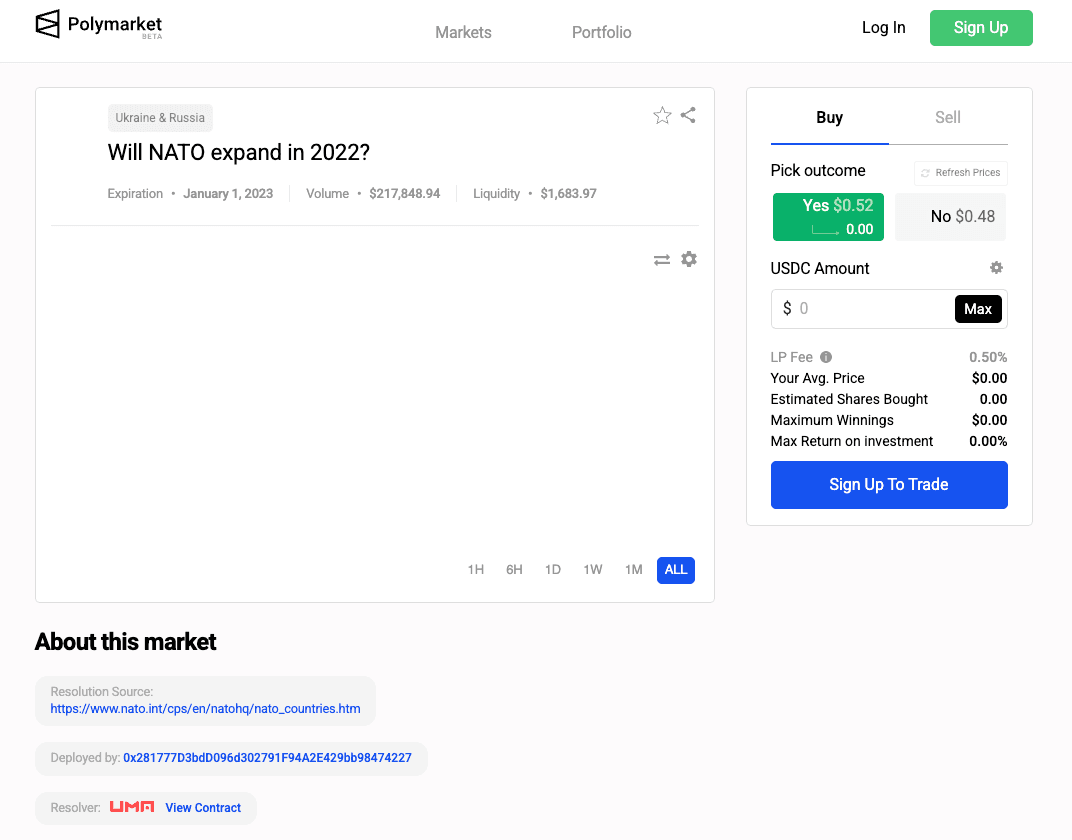
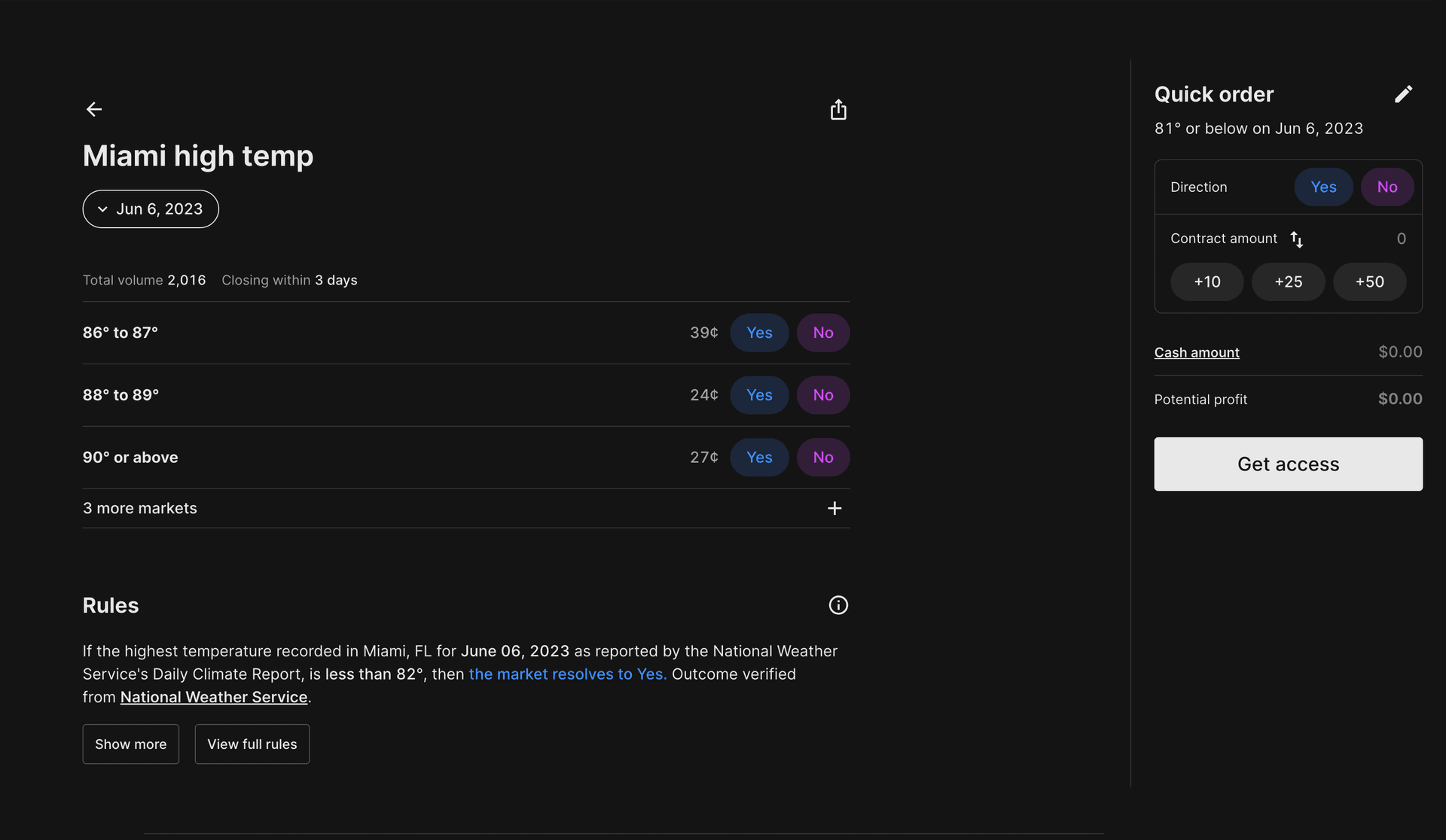
This is what Polymarket and Kalshi looked like in 2022:

Polymarket interface from 2022-2023

Kalshi interface from 2022-2023

Three years later, their interfaces are almost identical:

Polymarket interface in 2025

Kalshi interface in 2025

While this made sense initially for early user acquisition, the lack of any meaningful changes directly affects market efficiency, liquidity provision, and price discovery. Opinionated frontends and aggregators should differentiate themselves along different axes to develop specific tools that people want.

Third-party frontends have similarly failed to innovate thus far, despite the clear opportunity. Prediction markets are still awaiting their native trading interfaces.

In this post, I outline six problems with prediction market interfaces today. For each problem, I offer commentary and a solution.

2025-11-15

The Future of Play Money Prediction Markets

The Wikipedia model


Play money prediction markets were once the only legitimate venue for participating in prediction markets due to regulatory concerns. They trained the first generation of prediction market traders and served as the first large-scale instantiations for how these markets actually work.

Many play money platforms, such as Manifold, have strong communities that persist to this day. However, the rise of Polymarket and Kalshi provides concrete incentives for sharp traders to trade on real money prediction markets instead of play money platforms. Many early Manifold traders became early active users of Polymarket and Kalshi.

In this post, I examine the performance of play money prediction markets compared to their real money counterparts. Following this analysis, I outline several advantages in their market structure and describe a future where they function as important actors in the prediction market industry.

Quantifying prediction market performance

The Brier score is a scoring rule that measures the accuracy of probabilistic predictions. It ranges from 0 to 1, where 0 represents perfect accuracy and 1 represents the worst possible predictions.

The score is calculated as the mean squared difference between predicted probabilities and actual outcomes. For a single binary prediction, if you predict probability p and the outcome is o (1 if an event occurs, 0 if not), the Brier score = (p - o)². Lower scores indicate better calibration and resolution of predictions.

Brier.fyi uses Brier scores to evaluate prediction market accuracy across four prediction market platforms: Polymarket, Kalshi, Manifold, and Metaculus. Polymarket and Kalshi are the two largest real money prediction market platforms. Manifold and Metaculus are the two largest play money platforms. Manifold uses "mana", which is play money currency. Metaculus operates as a forecasting website with slightly different prediction mechanics, but can be interpolated into many of the prediction market aspects.

Polymarket, Kalshi, Manifold, and Metaculus have Brier score as follows:

CategoryPolymarketKalshiManifoldMetaculus
Culture0.1734; A-0.2996; A-0.2325; D+0.2018; F
Economics0.1245; A-0.0727; A-0.1218; C-0.1201; C+
Politics0.1634; B0.1606; B+0.1779; C0.1489; C+
Science0.0622; A0.1046; C+0.1946; C0.2286; A-
Sports0.2519; A-0.3364; A-0.4329; C-0.3958; D
Technology0.1534; B0.2997; A0.2785; C+0.1742; C+
Overall0.1652; B+0.1982; A-0.2118; C0.1664; C

Unsurprisingly, real money prediction markets outperform their play money counterparts. This makes intuitive sense: if price discovery occurred on play money prediction markets, someone could easily arbitrage between play money markets and real money markets.

Nevertheless, they perform better than one might expect and actually outperform real money prediction markets on certain axes such as science markets (Metaculus vs Kalshi).

2025-11-14

Prediction Market Prices != Probabilities

Context is that which is scarce


One of the most alluring things pro-prediction market people say to skeptics is, "If the price is incorrect, you can fix it and make money doing so!"

Polymarket's own website states this equivalent as fact:

Prices = Probabilities.

Prices (odds) on Polymarket represent the current probability of an event occurring. For example, in a market predicting whether the Miami Heat will win the 2025 NBA Finals, if YES shares are trading at 18 cents, it indicates a 18% chance of Miami winning.

These odds are determined by what price other Polymarket users are currently willing to buy & sell those shares at. Just how stock exchanges don't "set" the prices of stocks, Polymarket does not set prices / odds, they're a function of supply & demand.

The logic mirrors the question posed to market bears who performatively claim asset prices are overvalued: "Are you short?" Here is a liquid venue to express your view and profit if you're right. When asked, most aren't actually short.

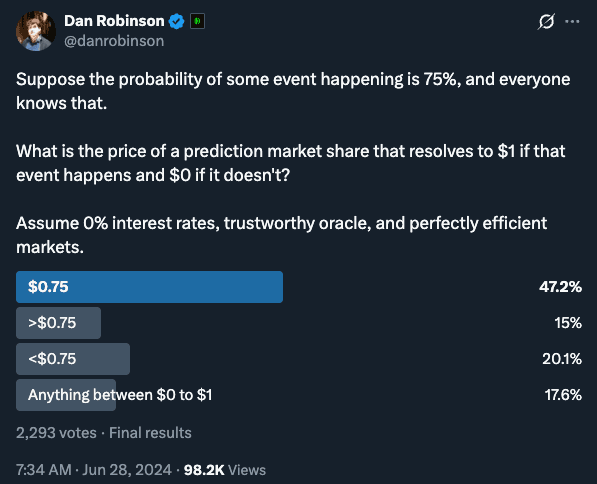
Last year, Dan Robinson posted a theoretical question about prediction markets in an X poll, asking what the price of a prediction market would trade at, given a known probability of an event occurring:

Dan Robinson's X poll on prediction market pricing

According to Dan, only 403 out of 2,293 people answered this correctly.

Stop here to think about it before scrolling down for Dan's solution.

Dan's solution

If the title didn't already give it away, it is not the most popular answer: $0.75 (A).

Dan claims that the answer is D: Anything between $0 to $1. His rationale is as follows:

2025-11-13

Why did it take so long for prediction markets to find product-market fit?

7 explanations


The Iowa Electronic Markets pioneered the first modern instantiation of a prediction market in 1988, allowing academic researchers to trade contracts on political outcomes. DARPA experimented with prediction markets for intelligence gathering through its Policy Analysis Market in the early 2000s, but was quickly shut down due to some markets being associated with assassination markets of political leaders.

Companies like Google and Microsoft have experimented with internal prediction markets to forecast project timelines and product success. InTrade emerged as one of the first major public platforms, gaining attention for its accurate predictions of elections and other events before shutting down in 2013. Augur launched in 2018 on Ethereum but struggled to gain traction.

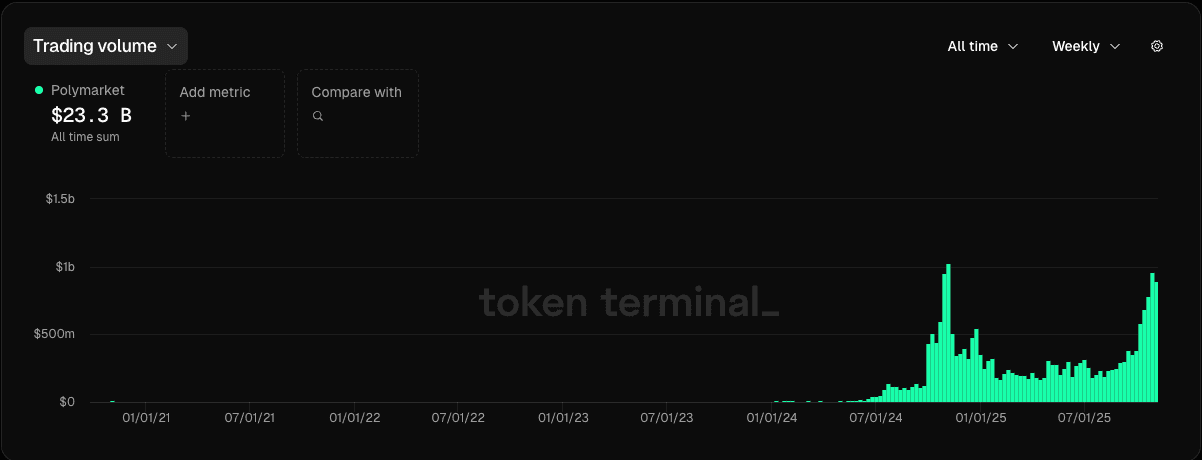
In 2020, Polymarket did $11.3M of volume during the week of the 2020 US presidential election and had effectively zero volume until 2024.

Polymarket volume chart showing growth

Various implementations of prediction markets have been attempted over the past decades. Yet they only achieved cultural product-market fit within the past year.

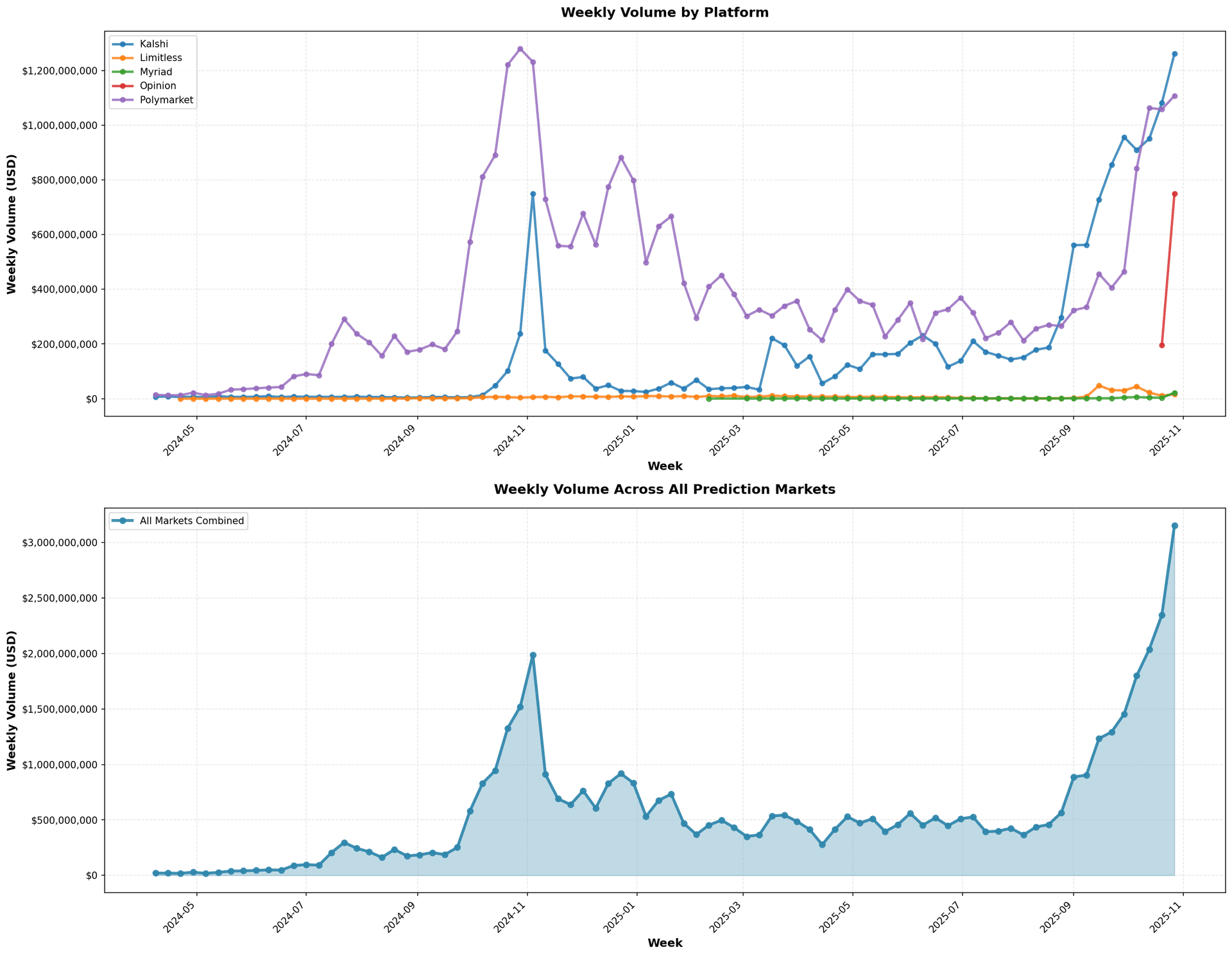
Today, prediction markets process over $3 billion weekly. New partnerships emerge daily to integrate prediction markets into sports, news, and search.

In this post, I provide seven explanations, ranked from most to least likely, for why prediction markets took so long to find product-market fit.


1. US regulatory agencies outlawed the creation of prediction markets.

The CFTC effectively banned prediction markets for decades through aggressive enforcement. InTrade shut down in 2013 after regulatory pressure. Augur launched in 2018 but struggled to gain traction, partly because operating in regulatory gray areas limited legitimate user acquisition. The few attempts to obtain licenses faced years of legal battles with uncertain outcomes.

Sophisticated participants (traders, market makers, institutions) avoided unlicensed platforms due to legal risk, instead opting to trade correlated assets or one-off event contracts OTC. Without sophisticated participants, markets remained thin and poorly priced. Without good prices, platforms couldn't demonstrate value to regulators.

2025-11-12

The Case For Alternative Ordering Mechanisms in Prediction Markets

Priority batch auctions as one better market structure to create more liquid prediction markets


The four major prediction market platforms, Polymarket, Kalshi, Opinion, and Limitless, all facilitate price discovery through an orderbook. Each market has an orderbook for each YES/NO outcome, which lists buy offers waiting for a compatible sell offer and vice versa.

The matching engine for the top four orderbooks occur offchain, as onchain orderbooks still remain unviable. All markets are matched first-come-first-served (FCFS), with the exception of live sports on Polymarket (more on this later). FCFS means that trades are processed exactly in the order that they are received. These orders are then processed by the orderbook matching engine based on price-time priority.

FCFS requires the public to trust that the companies running the infrastructure are operating honestly and not re-ordering transactions. In traditional markets, there is robust regulation to ensure that orders are processed on a FCFS basis. In prediction markets, these guarantees are much weaker given that the state of regulation for prediction markets is still in its infancy.

Nevertheless, orders are still very likely processed FCFS as existing prediction market platforms are not incentivized to risk their reputation by modifying their ordering mechanisms without notice. This is generally confirmed by rudimentary testing.

FCFS creates wider spreads and other negative externalities

FCFS creates a latency war to update prices as close to real time as possible. This creates a large incentive to co-locate with the matching engine of the orderbook to have the lowest latency and the ability to react to news events the fastest.

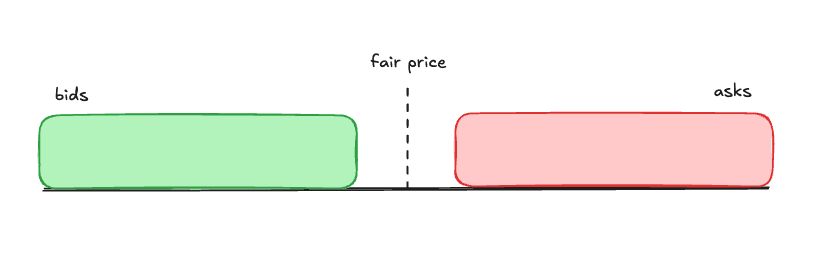
Recall that market makers make money by buying at a lower price and selling at a higher price. They make money when the fair price is between their bid and ask spread.

Market maker spread diagram showing fair price between bid and ask

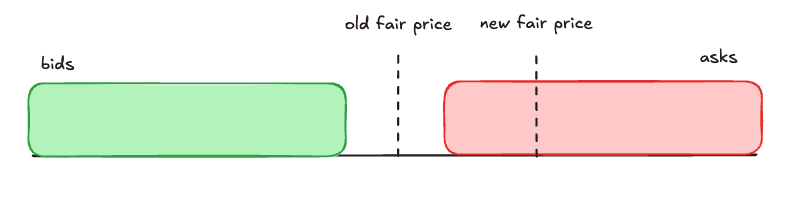
When the fair price moves before they can pull their stale quotes, they are picked off by takers.

Diagram showing market makers being picked off when fair price moves
2025-11-11

Prediction markets are leaking $78M annually

15 million free riders and counting


Thirty-seven years after the first modern prediction market was launched at the University of Iowa, prediction markets have finally found product-market fit.

Weekly prediction market volume crossed $3B for the week starting October 27, 2025, and it is on a clear trajectory to play a large role in finance, news, and everyday life.

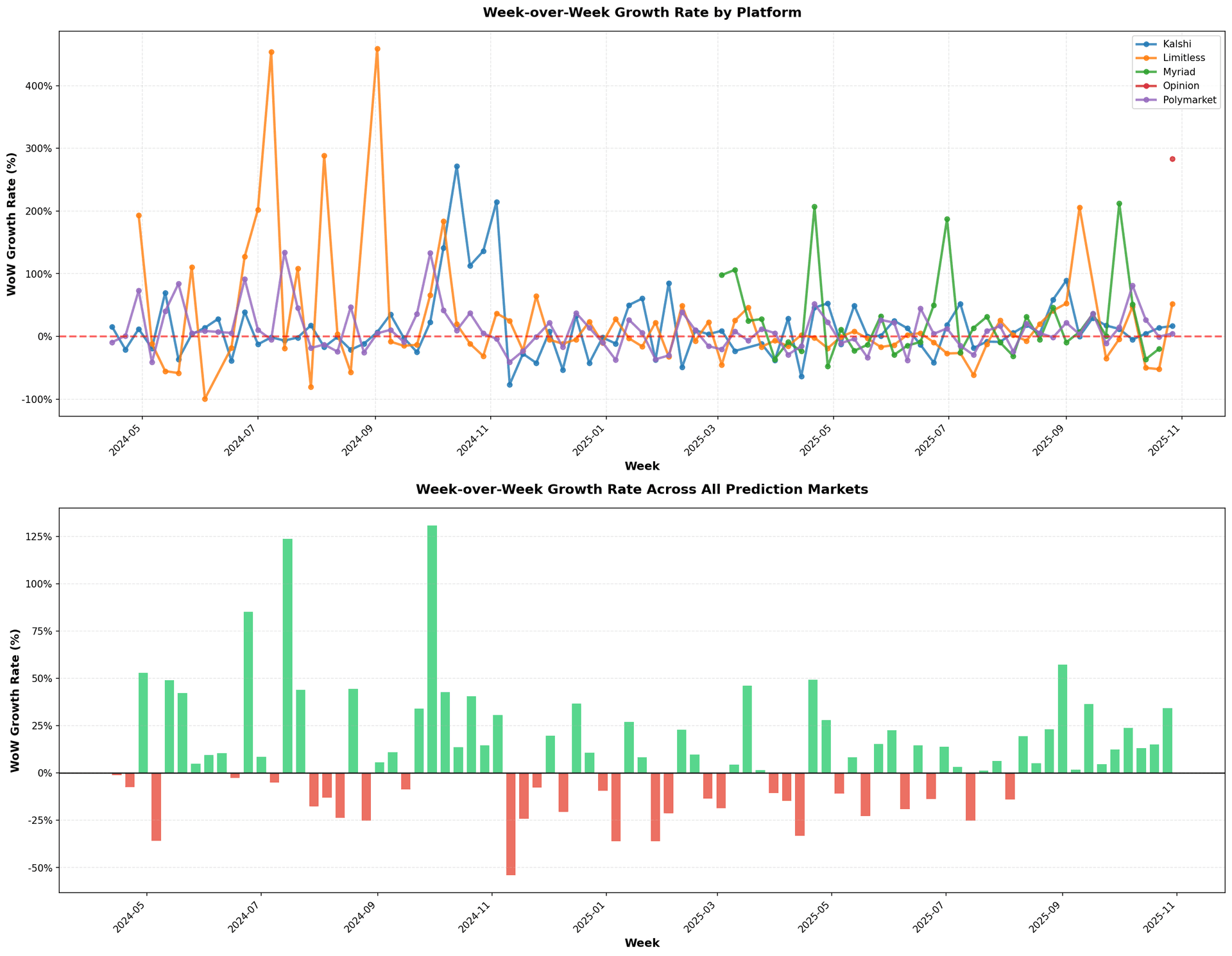
Prediction market volume is growing at 20-30% week-over-week:

Prediction market volume growth rate

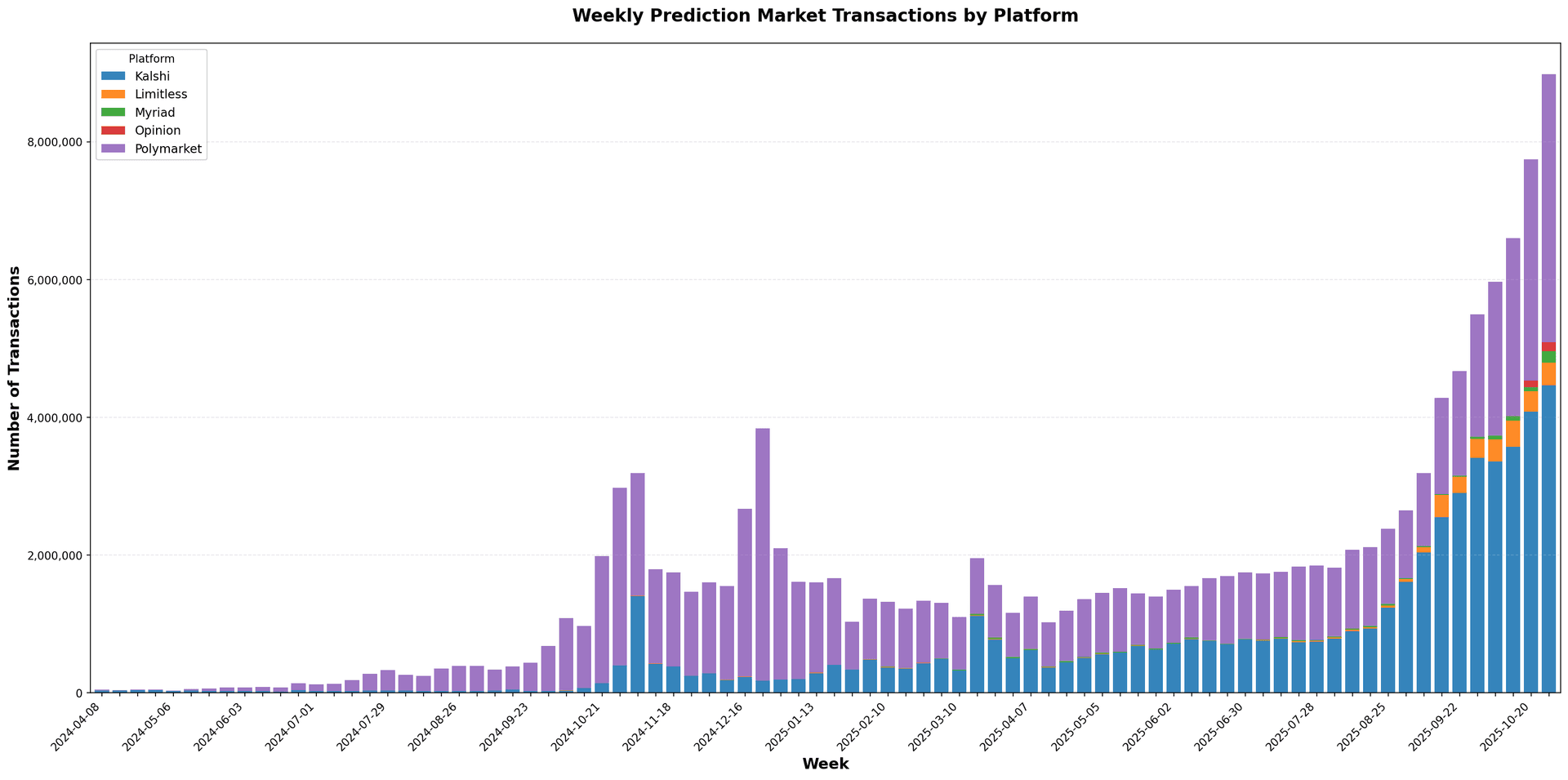
For the week starting October 27, 2025, there were 9 million transactions across all prediction markets, and it is increasing by roughly 20% week-over-week:

Prediction market transactions

It is too early to predict where the growth rate will begin to plateau. Extrapolating using a 5% week-over-week growth rate, weekly prediction market volume will be $10B in May 2026 and $36B in November 2026.

For reference, weekly volumes for global FX, US equities, and US equity options sits around $40 trillion, $2 trillion, and $750 billion, respectively. Spot volume across crypto onchain exchanges was $56 billion for the same week of October 27, 2025.

Some see the rise of prediction markets as evidence that society is at last catching up to the theories they've championed for decades. Others argue that this is a temporary equilibrium, heavily distorted by the gambler archetype willing to consistently take negative expected value bets, and that prediction markets are not an incentive-compatible market structure.

2025-11-10

Blame as a Service (BaaS)

Productized scapegoating


Instagram and Twitter were the defining cultural companies of the 2010s. These platforms created explicit status games where users compete for social capital via metrics such as followers and likes, creating a world where online perception is upstream of real-world outcomes. The social dynamics of these platforms has been extensively written about.

Companies are now finding themselves dragged into the same status games. They are increasingly going direct, with edgy X accounts and marketing stunts. In the PR-driven information age, companies have higher budgets allocated towards managing their social perception. Companies are particularly interested in paying for services that reduce their likelihood of being associated with negative press. These social dynamics create demand for professional blame absorption.

Just as Software as a Service lets companies rent specialized technology services instead of building it, Blame as a Service (BaaS) lets companies rent scapegoats instead of becoming them. These third-party BaaS firms absorb the backlash from unpopular but profitable decisions, allowing their clients to pursue what actually drives their bottom line without sacrificing their carefully cultivated brand image.

The characteristics of a typical BaaS company includes:

  1. Offers a bundle of services that conceal their true value proposition of blame absorption
  2. Shields elite decision-makers from decisions with negative externalities
  3. Benefits from network effects as their blame-absorption capacity scales

We are beginning to see more BaaS companies in the Average is Over era. The elite class across industries is smaller but growing in power and increasingly willing to pay for institutional lackeys that protect their interests while maintaining plausible deniability. BaaS companies engage in third derivative work. They don't do the work directly or build the tools, instead deciding what should be done and absorbing the blame for the consequences.

In this post, I examine the market structure of three BaaS companies operating today and one future BaaS company archetype.

McKinsey

McKinsey is the canonical example of a BaaS company. The decision to hire McKinsey is made by the executives of a company, nominally to improve the company's bottom line.

A company may be genuinely interested in hiring McKinsey to get an outsider's view on their reasoning before undergoing an action, as decisions could affect billions in enterprise value. But companies usually know what needs to be done before McKinsey walks through the door. At minimum, they hire McKinsey to execute and check financial projections. They have the deepest contextual knowledge of their field, whether the plan is expanding product lines or cutting thousands of jobs.