2025-08-26

Don’t Build an Audience

Great work always finds the people who matter


On his podcast with Scott Alexander and Daniel Kokotajlo, Dwarkesh makes the claim that everything that is good gets read by all the right people:

“I feel like this slow, compounding growth of a fan base is fake. If I notice some of the most successful things in our sphere that have happened; Leopold releases Situational Awareness. He hasn’t been building up a fan base over years. It’s just really good…I mean, Situational Awareness is in a different tier almost. But things like that and even things that are an order of magnitude smaller than that will literally just get read by everybody who matters. And I mean literally everybody.”

Scott responds with:

“Slightly pushing back against that. I have statistics for the first several years of Slate Star Codex, and it really did grow extremely gradually. The usual pattern is something like every viral hit, 1% of the people who read your viral hits stick around. And so after dozens of viral hits, then you have a fan base. But smoothed out, It does look like a- I wish I had seen this recently, but I think it’s like over the course of three years, it was a pretty constant rise up to some plateau where I imagine it was a dynamic equilibrium and as many new people were coming in as old people were leaving.”

Watch the full clip here: Dwarkesh Podcast

The underlying assertion that Dwarkesh is making is that the content market for ideas is very efficient. Scott agrees conceptually but to a much lesser degree, citing his own experience in the early days of Slate Star Codex, and indicates that he considers the market to be less efficient than Dwarkesh does.

As a recovering efficient markets believer, I am very skeptical of anyone claiming that any market is efficient. However, Dwarkesh is correct here. Stated precisely:

The content market for novel and interesting ideas is efficient, enabled by incentive-aligned market microstructure.

To avoid ambiguity, let me define exactly what I mean by that claim:

  • Content markets refer to markets that operate on internet rails. They have zero or effectively zero marginal cost and are non-rivalrous.
  • Efficient means optimally connecting suppliers (content creators) in such a way that maximizes consumer satisfaction. People are bounded by their time and care about consuming the best ideas and content.
  • Market microstructure refers to the mechanisms, tools, and systems that govern how content is discovered and distributed. [1]
2025-08-21

Career Advice That Doesn’t Suck

Work harder, bet bigger


I’ve taken a lot of career and financial risk, more than almost all of my peers. While I view my decisions as largely rational and effective, I tend to keep most of my decision rationales and work habits to myself.

Much of my decision to take early career risk can be attributed to select blogs, books, and talking with a lot of people, especially older mentors. Since most of my friends already think I'm pretty weird, I figured I'd open-source some of my work habits and decision rationales that have shaped my approach:

  • Working multiple jobs for a period of time and using the earnings to have a period of unemployment (what I’m doing currently). This has enabled me to prevent myself from (1) being anesthetized by my job and becoming complacent, and (2) giving myself full latitude to work on projects in-depth, not as perpetual half-assed “side projects”.
  • Two super intense deep work days per week where I go zero to one with no distractions. This is usually Sunday and Tuesday, where I work with the aim of having the highest output day possible. The other days are spent largely editing the work product from these days or otherwise lighter work modes.
  • Doing way more and trying way harder; no one is even trying. Successful people just have way more output than their peers who are often equally as smart and capable. “Work smarter not harder” is some of the worst advice I’ve received. You need to put in the hours and understand the context to determine what’s important and what’s not. July was a particularly high-output month for myself, writing 50k+ lines of code and 10,000 words, averaging 4 hours of deep work for 6 days a week.
  • Reading long-form books regularly, with 1-3 intensive subject deep dives per year on specific topics or classics. I schedule reading during lighter work periods since books become a major distraction during my high-output deep work sessions.
  • Not working on the hardest thing I can. You can make large contributions to many fields and working on the hardest thing is often irrational. My driving thought process is asking myself where I think I can make a large marginal contribution with my skill set.
  • Writing on the internet to sharpen my thinking and increase the surface area of serendipity. I write across a variety of topics and personas which allows me to have edges and peer groups at the frontiers of different subject areas. Take the initiative to meet people in person and learn about their production functions.
  • Understanding the long-term games worth playing. Becoming the best badminton or chess player is impressive but very capped. Think about playing in positive-sum environments where you can own a unique spot on a growing frontier.

I certainly do not advocate for most people to follow my work habits or career choices. It is best interpreted as real work habits from your friendly internet anon who isn’t successful (yet) and who has no incentive to lie. (If I really was successful, would I really be toiling away writing this blog?)

Lessons from Kelly

The Kelly Criterion is utilized in binary outcome environments and describes how much to wager for a bet given certain constraints. It is used to optimize long-term expected value of your bankroll. The inputs are:

  • The size of your current bankroll
  • If your bankroll is replenishable
  • The probability of an event occurring
  • Your edge in the market

In kind environments where feedback is honest and frequent, Kelly is a useful model. You can place 1 million sports bets and determine if you are a winning or losing player on average and use Kelly or fractional Kelly to give pointers on how much you should bet.

Kelly formalizes the natural intuition that you should bet larger when you have a bigger edge and less when your edge is smaller. The less intuitive part is how the math works out:

For even money (1:1) odds, Kelly suggests:

2025-08-11

Hyper-Optimized Children

For many parents, hyper-optimization is the preferred method for brute-forcing their children out of mediocrity.


NBA

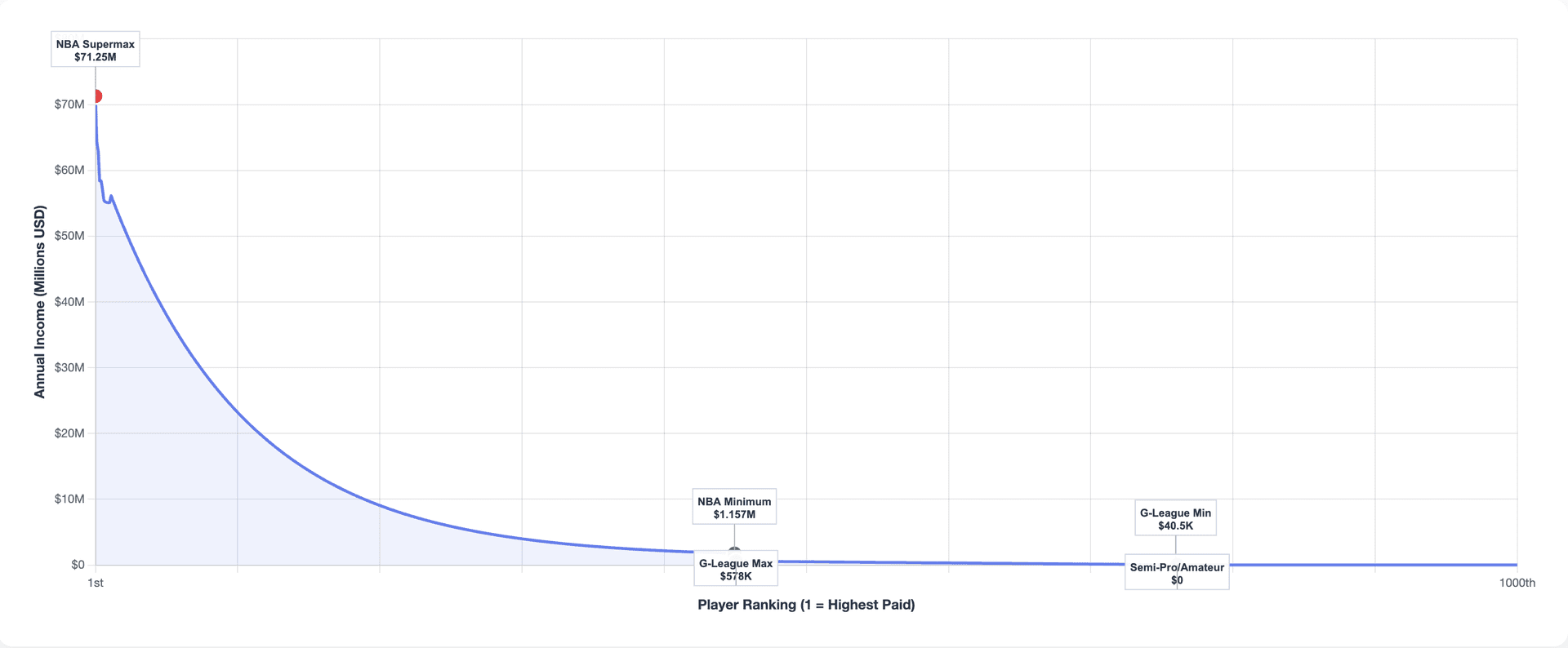
The NBA is one of the most competitive domains in the world. There are 450 active players in the NBA at any given point in time (15 players per team, 30 teams total). The distribution of annual income for the top 1000 basketball players in the world looks something like this:

In the 2024-2025 NBA season, the average salary was $9,191,285, and the median salary was $3,657,120.

With such a steep drop in income and prestige among the top 1000 basketball players in the world, it is no surprise that parents are doing all they can to surpass the 450 threshold and climb along the NBA salary curve to get as close as possible to the NBA supermax.

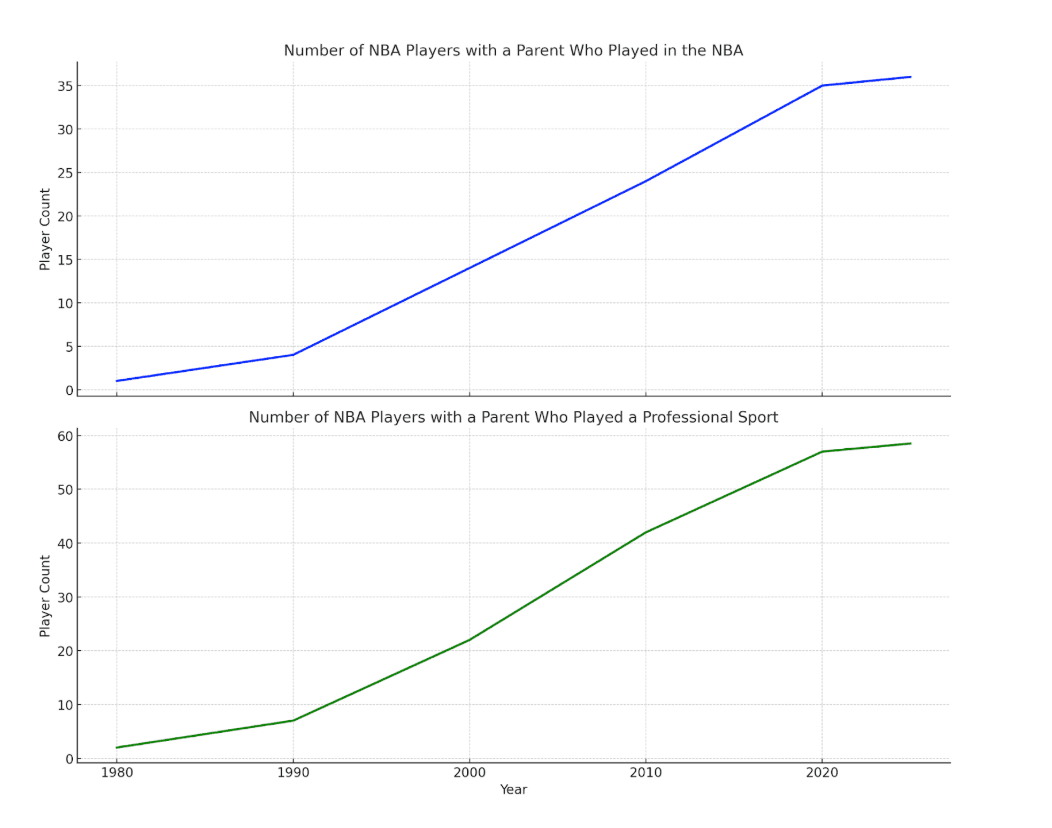
Young children who have a shot at making the NBA typically show a strong signal from a young age. The baseline attributes include height and athleticism. On-court IQ is becoming increasingly important and better measured with advanced statistics and cameras. These traits are correlated with parents with above-average genetics and the resources to provide their child with the best environment to develop. Parents who are 2+ standard deviations athletic and domain-intelligent are much more likely to have children capable of playing in the NBA.

This is intuitively true and becoming more and more empirically true every passing year in NBA data:

Description of the image

Naturally, these parents want their kids to be successful. When they see that their kid has the genetic makeup to be in the NBA one day, they pour in resources to have their kid achieve that goal. Parents center their lives around enabling their kids to develop their abilities and make the league.

The average NBA player is far more athletic, skilled, and smarter than NBA players just a decade ago. The average NBA player from the 80s would have no shot at being in the league today with how the game is played today. The game itself has been optimized to a local equilibrium of high-volume threes.

Because the skill floor is so much higher today, NBA players are expected to enter the league with a much higher baseline skill set. This is advantageous for kids who have been playing basketball for their entire lives and attending camps with retired NBA players. It is now normal to see kids play AAU, travel ball, and varsity basketball throughout the entire year.

2025-03-24

No One is Really Working

Justifying the High Salaries of Early-Career Professionals


The following are anecdotes of a typical work schedule for young professionals in established, tracked professions.

Following these profiles, I provide explanations for why young professionals command such high compensation, relative to what their work product would indicate.

Adam: SWE at a gaming company

Adam has been a SWE for four years. He first started coding when he was a young boy and quickly found that he had a knack for solving puzzles. He always loved video games and was excited to learn that he could have a lucrative career that included programming the very games he enjoyed growing up.

His day consists of pushing updates to backend servers in Go and writing relevant Typescript client code. Most problems don’t require much brainpower, meaning that he can push a change and spend the next 30 minutes on TikTok. Typically, when he refocuses himself, he finds that he one-shots the problem and moves on to the next problem. A good day would be merging a couple of PRs and some friendly Slack banter.

Adam has compounded his skills over the years, thanks to a strong culture, well-defined tasks, and a competent manager. He has a good work-life balance as he is able to finish projects quickly, though most do not even have hard deadlines. He makes sure to not work too fast or set expectations too high. This is an implicit learned behavior from his boss, who is also competent and not incentivized to ask for or create more work.

On average, Adam puts in 0-10 hours of deep work a week. The rest of his work hours are spent mindlessly coding, listening in on various meetings with his camera off, and on TikTok.

Adam went to a large engineering school. He was much sharper than his fellow students and didn’t have to work too hard to get good grades. He leveraged his connections and grades to eventually work at the gaming company he’d always dreamed of.

His typical week includes merging a couple of PRs and periodically managing a few interns. He generally prefers to work alone. He is conflicted about whether to go the IC route or the manager route. He’ll probably go the manager route because his manager told him it is the path of least resistance.

Adam thinks AI and AI-adjacent tools are crutches. He does not use Twitter.

2025-03-03

Why You Should Be More Cynical

Clinton Foreign Policy, $TRUMP and $MELANIA, and the Foundations of the Internet


This post is about how relationships, emotions, and incentives drive real-world outcomes over reason, ethics, lawful behavior, and market forces.

Foreign policy is guided by sex and approval

In 1995, Bill Clinton had a very public affair with Monica Lewinsky. In response, Hillary Clinton did not speak with Bill for many months due to the affair and the second-order effects of his infidelity.

The re-commencing of their relationship and the eventual forgiveness by Hillary is claimed to be traced back to her strong-arming her husband to bomb Serbian villages: [1]

Bombing Serbia was a family affair in the Clinton White House. Hillary Clinton revealed to an interviewer in the summer of 1999, “I urged him to bomb. You cannot let this go on at the end of a century that has seen the major holocaust of our time. What do we have NATO for if not to defend our way of life?” A biography of Hillary Clinton, written by Gail Sheehy and published in late 1999, stated that Mrs. Clinton had refused to talk to the president for eight months after the Monica Lewinsky scandal broke. She resumed talking to her husband only when she phoned him and urged him in the strongest terms to begin bombing Serbia; the president began bombing within 24 hours. - Source

The primary source here is shaky at best. But is something like this really beyond the realm of possibility for one of the most ambitious and socially intelligent Western female leaders with a long history of hawkish foreign policy tendencies? Hillary’s love language could very well be acts of war.

Founding stories are a psyop

Early-stage startups run on secrets and secrets often spread like wildfire. NDAs are only as good as the ability to enforce them. Your favorite application (Facebook, pump.fun) has a much more complex founding story than is publicly available, likely with some questionable espionage-esque behavior as a core propellant to reaching their heights.

Most participants understand this social contract and end up contributing and extending in-group dynamics. This includes connected individuals carefully crafting narratives for public consumption.

The founding stories of successful companies including Paypal, Flexport, and Notion are well-documented and leveraged as lore to attract customers and prospective employees. How much of these stories reflect reality versus a curated Girardian story to persuade others of their divine purpose?

2025-02-12

Your Life is More Over Than You Think


There’s a graph from Tim Urban that I think about often:

Description of the image

It never ceases to amaze me that you can literally see all the weeks of your entire life on a single sheet of paper. You have a very finite number of weeks in your life. [1] Every decision matters.

Time is the one scarce resource that affects everyone equally. Regardless of your background or socioeconomic status, everyone plays by these same constraints. [2]

However, reality is even more pernicious than what this graph shows. As you cross off each week of your life, you falsely believe that you are operating in a linear regime where each week is an equal proportion of your perceived life. In reality, your perception of time in life is better modeled on a logarithmic scale rather than a linear one.

Description of the image

At age 5, one additional year is another 20% of your life. At age 50, one additional year is only 2% of your life.

While our perception of time is not perfectly logarithmic, talking to people older than me leads me to believe that this heuristic is at least directionally true.

What should we do about this? How can we maximize our ability to get what we want in our lives?

Career implications

As early as possible, you should develop a thesis for what you want to do given your risk profile, work/life balance, and skillset. Your thesis can and should evolve as you grow older.

Intelligence is getting what you want out of life, and most people complain they aren’t getting what they want without any evidence of even a modicum of effort. You can get ahead of basically everyone in any field by putting in an ounce of effort. No one is even trying.

Don’t spread yourself too thin, but realize that there are unexpected returns to being a polymath and deriving cross-pollination insights. Choose 2-3 areas to do ten times as much in life. Deliberate practice over 2-3 areas for even a few weeks will put you at a massive advantage over the vast majority of the population. Compounding is still greatly underrated in practice, even though everybody knows about it.