2025-11-01

Architecting Reality

The best way to predict the future is to build it


A handful of engineers can now build attention algorithms that shape political and cultural discourse more effectively than any government. A team of two can create economic systems where millions transact daily and generate millions of dollars of profit per day less than one year after launch. A single engineer can rug model weights and cause people to commit suicide.

A small number of people don’t just participate in the world, they construct the rules the rest of us have to live inside. This is world building.

In a recent talk, Bruno Macaes succinctly enumerates the world building meta-game:

“There’s no greater power in the world than to build the landscape or the system within which others have to operate…A superpower encodes the game, a normal power plays the game.”

The distinction is not left/right or establishment/anti-establishment. It’s about world builders and world players. World builders and players used to be part of government-controlled institutions and organizations, but this is no longer true.

Macaes accurately notices that the stratification between players and builders is increasingly dominated by teams developing powerful technologies without explicit government control. He is able to parlay his knowledge to read and predict cultural signals. In a 2020 piece, he draws a sharp East–West contrast rooted in linguistic and epistemic norms:

“‘Do you know why the Chinese are so naturally good at deep learning? Because the black box has been part of Chinese society and Chinese culture since the very beginning. Zen meditation, yes, but not only. Chinese medicine. There is an input, some herb or infusion. You have no idea how it works, but it does. All you can do to get a different result is enter a different input.’”

Macaes’s framework, while provocative, reads like an oversimplified Grand Unified Theory that assumes a starting point and ending point, dismissing the middle as irrelevant path-dependency. This isn’t a unique indictment of Macaes; rather, it’s a more general academic and journalistic critique of caring about the messiness of reality. Traditional geopolitics operated through legible channels via sovereign states, formal treaties, and clear hierarchies. The new paradigm operates through institutional bypass and digital leverage, which remain opaque without deep immersion in frontier digital culture.

The shift from world player to builder isn’t new. History is filled with individuals who demonstrated competence, transcended their initial roles, and reshaped systems. What is unprecedented is the velocity and scale of this transformation.

2025-10-13

Title Arbitrage as Status Engineering

How novel titles reshape talent allocation


Over the past couple years, some tech companies have begun refactoring traditional job titles:

Old TitleNew Title
Solutions EngineerForward-Deployed Engineer (FDE)
Research ScientistMember of Technical Staff (MTS)
Product ManagerTechnical Product Manager (TPM)
HRHead of People
Prompt EngineerResearcher
UI EngineerProduct Engineer
AssociatePartner

Refactoring titles is a form of title arbitrage. Titles are an imperfect signal of how one contributes to an organization. They confer varying levels of status across different groups. Title arbitrage shifts the relative status of certain positions and changes what people want to work on. Some title refactors are simply name changes while others are signals that a company is taking an opinionated view on the world. Many companies also pair this with title deflation, abandoning external leveling schemes in favor of flatter hierarchies with these new designations.

Title arbitrage and deflation represent an attempt to rewrite tech’s status hierarchy and reshape its culture from the top down. In recent years, this has been led by companies attempting to usher in a new era of tech giants, most notably AI research labs and adjacent entities.

Company Motivations

Companies implement title arbitrage and deflation for the following reasons:

  1. New titles increase the status of certain jobs that are core to company success.

Certain roles are less sexy than others. Talented people naturally gravitate toward high-status positions and titles regardless of actual fit. New titles increase the status of certain roles and attract talent to roles they would have dismissed under their original labels.

Palantir pioneered the Forward Deployed Engineer (FDE) title. FDEs are critical to the success of Palantir as they develop custom solutions and relay frontier context that gets fed back into Foundry or Gotham. While FDEs are there to nominally serve as a solutions or integration specialist, sending sharp people (1) creates tighter feedback loops for customer satisfaction and (2) signals company strength, as most companies deploy average talent in customer-facing roles. When clients interface with Palantir’s top-tier FDEs, they are left impressed and ask themselves: if the FDE they sent to us is this impressive, how impressive is the rest of the company?

The status of the company and role enabled them to recruit sharp software engineers into technical consultant roles. Palantir was able to recruit out of the more technically-savvy (and likely higher g-factor) FAANG talent pool instead of the management consultant pool. You have to give someone a lot of perceived status to convince competent people to travel to random cities around the world to integrate data pipelines at 2 am.

To be sure, socially engineering smart people to work in customer-facing roles was necessary but not sufficient for the success of FDEs at Palantir. Rather, it is in conjunction with their business strategy and company architecture that enables the creation of software that stays years ahead of what everyone else thinks governments and enterprises need.

2025-09-23

Lessons From Poker

12 learnings and takeaways


When I was in university, I played a lot of poker. Looking back, I was sniped by poker because it promised a meritocratic environment where I could prove my skills while indulging my libertarian and anti-establishment instincts.

Every weekday, I was four-tabling Bovada and GGPoker games on my primary monitor while watching lectures on my second monitor at 3x speed. When I wasn’t playing, I was studying poker charts to improve my abilities.

I played seriously for about 6-8 months. I still play occasionally in-person now, on the order of 5-10 times a year.

The following are my takeaways from playing poker:

  1. Game selection is more important than theory.

Figuring out how to get into better games will yield better marginal results than studying charts and theory. There are times of day that are much, much more profitable to be playing than others. This forces you to think through incentives and run experiments on your own.

  1. Zero-sum games like poker are capped and you can quickly find yourself trapped in a local equilibrium.

The earlier you realize this, the better.

  1. The best players don’t play poker.

Ben Affleck, Nate Silver, and Haseeb Qureshi all played professionally or semi-professionally. They all could have made a career in poker but instead chose to utilize their skills in careers with uncapped financial and social upside.

2025-09-22

Steelmanning The Case For Consultants, Affirmative Action, and Alcohol

The strongest counterarguments against increasingly popular beliefs


Three ideas have gained remarkable momentum, even becoming consensus in certain circles:

  1. Consultants don’t do real work.
  2. Affirmative action puts diversity over merit and blocks the most talented candidates.
  3. Alcohol is bad for you and you should never drink.

True intellectual rigor demands we seek out the strongest possible counterarguments, even when they challenge beliefs that feel obviously correct. Laying out the strongest arguments for the opposing side ensures that we understand the other side from first-principles. If you can't articulate the strongest possible case against your own beliefs, you don't understand the topic well enough to have strong beliefs about it, and are subject to the public intellectuals and other cult-like individuals who present these ideas.

In this piece, I steelman the case for consultants, affirmative action, and alcohol consumption. Note that this is not what I necessarily believe, but what I believe are the strongest arguments in favor of each.

The Case For Consultants

Zeitgeist belief: Consultants don’t do real work. Consultants may work nominally long hours but do not add any significant value to firms, billing high rates for meaningless PowerPoints.

Steelmanned counterarguments:

  1. Consultants enable executives to take unpopular decisions by outsourcing blame to a third party.

Consultants are presented as unbiased third parties who are stewards for the company to increase its bottom line. Improving the bottom line often means cutting costs by laying people off. Executives utilize consultants as a scapegoat in laying people off to deflect the blame and ultimate responsibility for unpopular and difficult actions.

  1. Consultants can be more incentive-aligned than internal stakeholders.
2025-09-17

Omniscient Entities

Thank you for increasing my blogging ambitions


I have a lot of very sharp and capable friends. As I grow older, the more I witness an ever-widening chasm between what people can achieve and what people actually end up achieving.

The simplest explanation would be that some people are innately more capable than others and that their skills compound at a faster rate. While this is certainly true, it does not explain what you choose to work on and how hard you work.

Rather, anecdotal evidence continually suggests differences in outcomes are downstream of ambition. While some amount of ambition is probably innate, I have come to believe that much of ambition is environmental.

There aren’t very many reasons to be ambitious and work hard if you don’t have billionaire-level aspirations. Most somewhat educated people in America (and especially in Europe) act rationally by not working very hard at their job, yet lead a pretty comfortable life: baseline healthcare, money to afford most things, and ample free time.

If you’re one of these people that sees their job as a means to an end, odds are that you will assort with others who think similarly. With all your friends in a similar position in life, the group naturally homogenizes around comparable ambitions levels and naturally decays as you grow older. Once you find yourself in this local equilibrium with your identity inextricably linked to your job, friends, and lifestyle, it’s very hard to change.

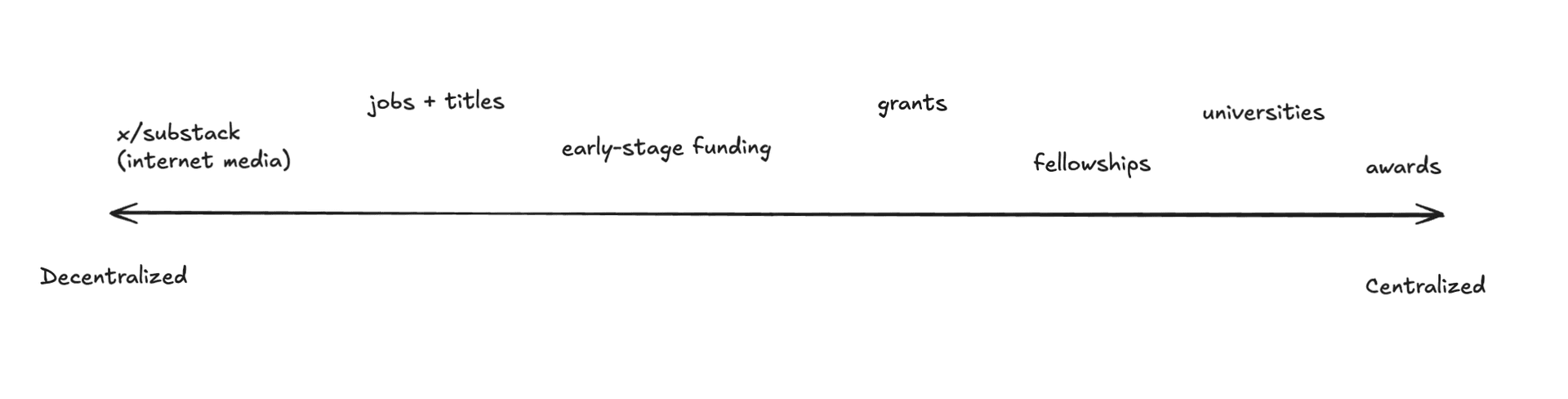
One of the only ways to change this at scale is through an external entity telling you that you are capable of greater things. Omniscient entities are credible people and institutions who increase ambition at scale by providing proactive positive reinforcement before any significant evidence of realized potential.

Modern secular omniscient entities include:

Description of the image

Examples of omniscient entities in action:

  • X/Substack/Internet Media: A collective of people provide early signals that you are producing valuable work in some dimension. You are capable of producing such good content that the audience signals that they are willing to allocate time in the future to consume the content you haven’t even created yet.
  • Job/Titles: Jobs and job titles not only signal competence to future employers but also tell you that you are the type of person capable of everything associated with the title. The intern turned junior developer is likely still a net negative on the organization, but after two years on the job under a good manager, they are able to autonomously contribute to an organization. This is the time where they earn the senior engineer title.or engineer.
  • Early-Stage Funding: A VC or an angel gives you money before you have any evidence of product-market fit. They believe that you will be able to figure everything out (attract talent to work for you, build a compelling product), maybe even more than you do yourself.
  • Grants/Fellowships/Awards: A committee or person decides that you are talented and grants you money and/or prestige along with a peer group of similarly skilled individuals. Proactive grants may be the catalyst that leads you to break out of your local equilibrium, change peer groups, and go on to do greater things.
  • Universities: Two similar students, one who went to Harvard and another who went to their local state school, start and end university with a similar skill set. The student who attended Harvard receives a Harvard diploma, but more importantly a sense that they are capable of doing greater things.
2025-09-11

Why hasn’t there been a new major sports league?

The market structure and incentives of US sports leagues


Every major US sports league today was founded in the 20th century. None of the ten largest leagues by revenue were created after 2000:

RankLeagueAnnual RevenueFounded
1NFL (National Football League)$20.2 billion1920
2MLB (Major League Baseball)$12.1 billion1903
3NBA (National Basketball Association)$11.34 billion1946
4NHL (National Hockey League)$6.6 billion1917
5MLS (Major League Soccer)$2 billion1996
6PGA Tour$1.83 billion1929
7UFC (Ultimate Fighting Championship)$1.406 billion1993
8WWE (World Wrestling Entertainment)$1.398 billion1953
9NCAA$1.38 billion1906
10WNBA (Women's National Basketball Association)$200 million1997

There have been over 65 well-funded attempts to create new sports leagues since the year 2000, with many billionaires and high-profile individuals including Thiel, Chernin, and Cuban backing various leagues that have all failed.

LeagueFoundedSuccess?
XFL2001 (re-launched in 2020)No
NWSL2013TBD
Fan Controlled Football2017, inaugural 2021 seasonNo
BIG3 (3-on-3 Basketball)2017No
Overwatch League2017No
Alliance Football (AAF)2018, inaugural 2019 seasonNo, bankruptcy in 1st season
Pickleball (MLP, PPA)2021TBD
League of Legends Esports2013Yes by mindshare, no financially
LIV Golf2021, inaugural 2022 seasonYes, semi-merged with PGA
TGL (Tomorrow Golf League)2025TBD

To put this in perspective, YC’s eight company first batch included Reddit (currently valued at $50B), Justin Kan and Emmett Shear (who went on to co-found Twitch), and Sam Altman.

The three leagues with even an argument for being not total failures are the NWSL, League of Legends Esports (LoL Esports), and LIV Golf. All have unique advantages over their counterparts, and yet none of them are profitable today or even on a very convincing path toward profitability.

In this piece, I examine how market structure and incentives explain the absence of new sports leagues in the United States over the past 25 years.

Following these explanations, I outline some first-order insights and strategies I would employ if starting a sports league.


  1. Legal structure and precedent greatly benefit incumbents.

The MLB has a legal monopoly over baseball in the US. They are able to block the formation of competing leagues, control franchise locations, and maintain the minor league system without antitrust scrutiny.

2025-09-09

How to scale a venture fund, lessons from FTX Ventures

Investing in Anthropic, Cursor, Figma, Circle, Solana, Sui by breaking the rules


Venture investing doesn’t scale. For an industry obsessed with investing in tech companies that scale through technology, venture is a tight network of individuals deploying relatively small amounts of capital (total VC AUM is ~$1T while private equity sits around $6T; global equities are around $78T). When venture firms add more partners or capital, they almost always perform worse in aggregate.

There’s a massive incentive for people to figure out how to scale venture firms. If a firm cracks this code can deploy capital across a wider array of companies and secure larger allocation into the winners. Numerous funds and platforms have tried different strategies to scale under their respective theses with varying degrees of success:

  • AngelList: anyone can sign up and spin up a venture fund at cost
  • Pioneer: the internet provides a unique substrate to identify talent globally via gamification and program metrics
  • SoftBank: founders optimize for the best financial terms and offering better prices can generate outsized winners
  • Y Combinator: young technical talent is underserved, business acumen is learnable on the job

Unlike many of their financial industry counterparts (investment bankers, consultants, etc.), venture capitalists are not known for their work ethic. Over the past decade, few firms have attempted meaningful innovations to scale venture funds. This can be partly attributed to the low personnel turnover rate and many less-than-ambitious people. Some are playing the management game, others spend twenty years coasting towards retirement, and some just aren’t that sharp.

FTX entering the venture game was a rare occurrence of an ambitious, resourced team deploying capital. FTX Ventures deployed over $5.2B in capital across more than 400 companies, with significant equity stakes in Anthropic, Cursor, Solana, and Sui. Today, that portfolio would be worth well over $20B.

FTX’s actions were illegal and inexcusable. But unlike most other venture firms, they employed a strategic, differentiated approach that leveraged their brand to deploy capital at scale. While they adopted some tactics from other firms, their implementation was a distinct point on the capital-strategy frontier and continues to influence venture firms today.

  1. Get onto the field and operate, double down on your best theses and comparative advantages. The best returns to investment are your social capital.

FTX started with Alameda when they were trading on Binance market making and running a hedge fund. Instead of using money and social capital from Alameda to start a venture firm, they started FTX to compete with Binance as they saw the benefits of creating a centralized exchange. (Perhaps too many benefits.)

Matt Huang, general partner at Paradigm and investor in FTX, is now running Tempo. Huang is uniquely positioned to lead Tempo given his experience as the founder of one of the largest crypto venture firms along with the backing of Stripe (where he also sits on the board).

To be sure, FTX did not start this trend. Keith Rabois started OpenStore while working as a partner at Founders Fund. Fellow PayPal mafia member Max Levchin started Affirm while running his venture firm SciFi. FTX pushed this approach further, running multiple operations in parallel to create compounding value and showing that running multiple operations is a strategic advantage, not a distraction.

2025-08-27

Notes on Shadowing a Hospitalist

16 observations on hospital culture and incentives


I recently shadowed a hospitalist during a 10-hour shift. A hospitalist is a generalist doctor responsible for patients while they are in the hospital. They go through similar training to the doctors you see for your annual check-ups.

Unlike ER doctors, who handle immediate crises hour-by-hour, hospitalists manage the day-to-day care of patients with serious but not immediately life-threatening conditions.

At any given time, a hospitalist usually manages 8–10 patients, most of whom are new to them. Their job is to quickly gather information from medical records, patient conversations, and test results in order to make diagnoses and eventually discharge patients.

Hospitalists function as medical coordinators. They are trained in high-level diagnosis but quick to refer to specialists for specific interventions. In many ways, they act like PMs of the hospital: aligning stakeholders, tracking progress, and ensuring patients are on course. They can order tests such as MRIs but typically leave interpretation and detailed recommendations to specialists (e.g. surgery).

The following are a select assortment of notes from my visit:

  1. Everyone jokes about death.

Everyone including the doctors, nurses, and support staff all joke about death in a way that is jarring to an outsider. This is best interpreted as emotional compartmentalization as a survival mechanism, not callousness. This makes sense, as it enables them to create a barrier between themselves and death. I imagine it’s one of the most effective ways to create a positive work environment while enabling everyone to do their best work without being depressed all day seeing people who are about to die.

  1. Verbal communication dominates for up-to-date knowledge transfer, while written notes are often an afterthought.

When I first arrived, four surgeons were holding a stand-up meeting at a nearby table. The overnight surgeon recounted the nuances of a surgery she had just performed, while the others tried to listen and skim the patient’s chart at the same time. She had to repeat herself multiple times as they asked questions she had already answered.

When doing the morning rounds, the hospitalist never took notes during the meeting. The two medical students doing their rotation were taking notes in their notebook. In the hallway after meeting with the patient, the doctor and the medical students would discuss diagnoses and recommendations for next steps. There was very little disagreement as the next steps were usually clear. In one instance, the medical student reminded the hospitalist of one of the symptoms that the hospitalist had forgotten about during the 15 minute conversation. The hospitalist usually would keep everything to memory but sometimes wrote a quick 1-5 word note on their phone for future charting.